There is a pattern I see again and again in nonprofit leadership.
A decision is made thoughtfully, collaboratively, with the right people in the room. It aligns with the mission. It makes sense given the information available.
And then…(Dun, Dun, Dun)
Someone questions it.
A board member hesitates.
A staff member raises a concern.
A funder offers a different perspective.
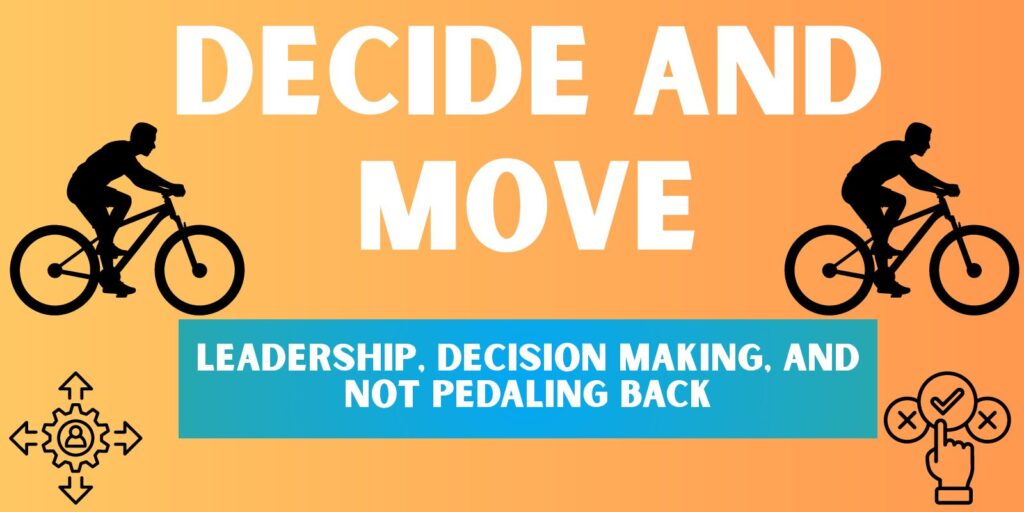
And suddenly, the organization starts pedaling back.
Not because new information has emerged.
Not because the strategy was flawed.
But because discomfort showed up.
So the organization slows. Reworks. Reconsiders. Sometimes reverses course entirely.
And what gets lost in that moment isn’t just time, it’s momentum.
Because leadership, like riding a bike, depends on forward motion. The moment you hesitate too long, you lose balance.
The Real Risk Isn’t the Decision
Nonprofit leaders are often framed as risk-averse, but I don’t think that’s quite right.
What I see more often is this: leaders are navigating environments where the cost of being wrong feels incredibly high. Funding is limited. Stakeholders are many. Missions matter deeply.
So we compensate by trying to get it exactly right.
We gather more input.
We seek more alignment.
We wait for more certainty.
But here’s the reality:
The biggest risk in nonprofit leadership is not making the wrong decision. It’s pedaling back on one that was already decided.
When you pedal back, you go nowhere, wheels keep spinning, but you are not any closer to your destination.
Indecision doesn’t protect your organization. It drains your energy and lets the air out of your tires before you’ve even moved forward.
Why We Pedal Back
It is all about uncertainty and insecurity, like taking the training wheels off.
1. Stakeholder Gravity
Nonprofits are built to be collaborative, and that’s a strength. But it can also create a dynamic where every voice starts to feel like a brake.
Input is essential.
Consensus is not.
When leaders blur that line, decisions lose traction and forward movement stalls.
2. Scarcity Mindset
When resources are tight, every decision can feel irreversible.
But most decisions aren’t.
We treat small and mid-level decisions like a steep uphill climb when, in reality, they’re just a shift in gears.
3. Discomfort with Disagreement
This is the one that shows up most quietly.
A leader makes a call. Someone disagrees. And instead of holding steady, the instinct is to adjust course immediately.
But disagreement isn’t a sign you’ve hit a dead end.
It’s just a kink in the chain, something to notice, maybe adjust around, but not a reason to stop riding altogether.
Confidence Is Not Certainty
One of the biggest misconceptions about strong leadership is that confident leaders know they are right.
They don’t.
They strap on their helmet, lean forward, and keep moving, even when the trail isn’t paved.
Confidence in decision-making isn’t about ego. It’s about clarity:
- Clarity of mission
- Clarity of priorities
- Clarity of who holds the decision
And most importantly:
Clarity about when a decision is made, and what it takes to switch gears.
What It Looks Like to Decide and Move
Strong nonprofit leaders don’t avoid input. They structure it.
They don’t rush decisions. They time-bound them.
And once a decision is made, they don’t keep circling back every time the road gets uneven.
Here are a few practices that keep leaders moving forward:
1. Separate Input from Authority
Invite perspectives. Ask good questions. Create space for discussion.
But be clear:
Who is steering the bike?
If that’s not defined, everyone starts grabbing the handlebars,and you don’t go anywhere.
2. Time-Box the Decision
Not every decision requires a long uphill climb.
If it’s reversible, make it faster.
Waiting for perfect information doesn’t improve the ride,it just keeps you standing still.
3. Normalize Disagreement
If no one ever pushes back, you’re not getting real input.
If someone does push back, it doesn’t mean you need to stop.
It just means you may need to adjust your balance,not abandon your direction.
4. Define What Would Change the Decision
Before finalizing a decision, ask:
What would actually require us to switch gears?
If that threshold isn’t met, the direction holds.
Otherwise, you risk stopping every few feet to reconsider the route.
5. Keep Air in Your Tires
This is the piece leaders don’t talk about enough.
Confidence isn’t just about the decision,it’s about maintaining the energy to keep going.
Second-guessing, over-processing, and constant revisiting slowly deflate your momentum.
Clarity, consistency, and forward movement? That’s what keeps your tires full.
When You Should Switch Gears
This isn’t about rigidity.
There are times when you should adjust: (on your left – iykyk)
- New material or data emerges
- External conditions change significantly
- The decision clearly isn’t producing results
That’s a strategic shift.
But that’s different from:
- Someone being uncomfortable
- A new opinion enters the room
- The natural resistance that comes with change
Not every bump in the road requires a new direction.
The Leadership Discipline No One Talks About
We talk a lot about strategy, vision, and innovation in the nonprofit sector.
We talk much less about the discipline required to keep pedaling once you’ve chosen a direction.
But that discipline is what creates:
- Organizational clarity
- Team confidence
- Forward momentum
Without it, even the strongest plans lose speed before they ever gain traction.
A Final Thought
If you’re leading an organization right now, here’s the question I would sit with:
Where are you pedaling back on decisions that were already strong, not because they’re wrong, but because they’re uncomfortable?
That’s often where your leadership edge is.
Because at the end of the day, your team doesn’t need you to ride perfectly.
They need you to keep moving.
They need you to stay steady.
They need you to lead.
And everyone has a smooth ride.