Part 1 of a 2-part series. Read Part 2 here.
Minnesota Fringe quadrupled individual donations year/year by expanding into Peer-to-Peer (P2P) strategies for Give To The Max Day. Could your organization be next?
Imagine you get a call from a supporter. She’s excited, energized, and wants to do a fundraiser for your organization. This happens more than most people realize, and how you respond to that call matters more than you might think.
Scenario one: you don’t have anything set up. So you spend the next few hours building a custom donation page, walking her through how to use it, and troubleshooting along the way. She goes out, shares it with her network, and raises $10. You’ve just traded three hours of staff time for ten dollars. Not a great return.
Scenario two: you’ve been burned before. So you tell her you don’t currently offer that kind of campaign. She’s disappointed. Maybe she moves on. Maybe she was the person who would have raised $3,000 if you’d given her the right tools. You’ll never know.
Neither of those outcomes is good. And both of them are completely avoidable. That’s what this series is about.
I’ve been helping nonprofits run P2P campaigns for over 20 years, building them, training fundraisers, and watching what works and what doesn’t. Both of those scenarios above are real. I’ve seen them more times than I can count. What follows is what I’ve learned.
Before we get into the how, let’s get clear on the what.
There’s a lot of confusion about what peer-to-peer fundraising actually is. The terms get mixed up constantly, and it matters because they describe genuinely different approaches with different strengths.
Traditional fundraising is what most nonprofits do most of the time. Your organization makes the ask directly to your supporters. You send the email, the letter, the appeal. It’s one organization talking to many people, and it only reaches people who already know you exist. That’s not a knock on traditional fundraising. It works and it’s essential. But it has real limits.
Crowdfunding is when an organization or individual raises money from a large number of people, typically online, in smaller amounts. Think GoFundMe, Kickstarter, or Indiegogo. It’s still your organization making the ask. You’re just doing it through a platform designed to spread the message. Crowdfunding works well for specific, time-limited needs with a compelling story: a new van, equipment for a program, a building project. The key thing to know is that the organization is still the one doing the asking.
This is also where Facebook Fundraisers live, and it’s worth saying plainly: Facebook Fundraisers are not a great P2P tool. More on why in Part 2, but the short version is that you don’t own the donor data, you can’t follow up effectively, and you’re training donors to give through a platform you don’t control. There’s a role for Facebook in promotion, but it shouldn’t be the foundation of your fundraising infrastructure.
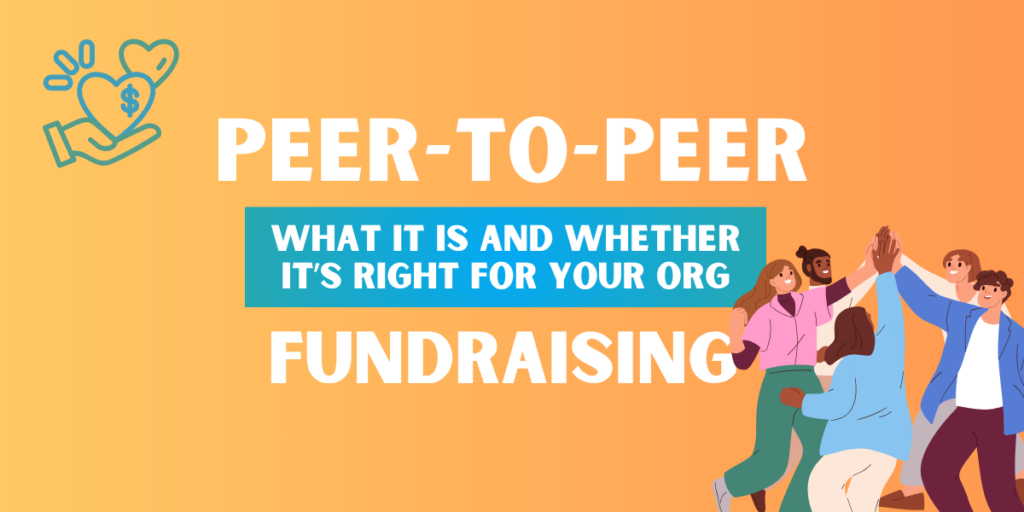
Peer-to-peer fundraising is different from both of those, and the difference is significant. In P2P, your supporters raise money on your behalf by reaching out to their own networks. Friends asking friends. You are not making the primary ask. A person your donor already knows and trusts is. That single shift changes everything about how the message lands.
Why it works, and why it works especially well right now.
People give to people they know. That’s not a new insight, but P2P fundraising is built around it in a way that traditional fundraising simply isn’t. When someone who cares about your mission goes out and asks their friends to donate, they’re lending their credibility and their relationship to your cause.
I’ve been doing P2P fundraising long enough to have watched this play out hundreds of times. An email blast from your organization might convert 1 in 1,250 recipients. That’s the M+R benchmark. When one of your supporters sends a personal ask to their own friends and family? The response rate jumps dramatically. You’ll see “1 in 4” cited in P2P training circles, and while I can’t point you to a single definitive study, I can tell you it matches what I’ve seen. The messenger matters as much as the message. In P2P, the messenger is someone the recipient already knows and trusts, and for smaller organizations, that advantage is even more significant than it sounds.
You don’t have a marketing budget that reaches thousands of strangers. What you do have is a group of people who believe in what you’re doing. P2P gives those people a structured, simple way to act on that belief and to bring new people into your orbit who would never have found you otherwise.
The other thing P2P does well is deepen engagement. Someone who fundraises on your behalf is significantly more invested in your mission than someone who simply donates. They’ve put their own reputation on the line. That tends to stick.
Who makes a good P2P fundraiser?
Most organizations underestimate this. You don’t need to go find strangers to recruit. Your best P2P fundraisers are almost certainly already connected to you: longtime donors who talk about your work regularly, volunteers who are deeply embedded in your community, board members who want a concrete way to contribute beyond their own gift, alumni of your programs, and staff who want to do more than their job description allows.
The goal isn’t to ask people to do something uncomfortable. It’s to give people who already care about you a simple, low-friction way to share that care with the people in their lives.
Is P2P the right fit for your organization?
Not every organization is ready for P2P, and that’s fine. Here’s a simple way to think about where you stand.
P2P might be a good fit if:
- You have at least a handful of passionate supporters who regularly talk about your work
- You’re looking for ways to reach new donors beyond your current list
- You want to give board members or volunteers a structured way to fundraise
- You’re willing to run a small test before going all in
It might not be the right time if:
- You don’t have a basic online donation process in place yet
- Your organization is in the middle of a leadership or operational transition
- Your team is already stretched with no capacity to support a campaign
Crowdfunding might be the better first step if:
- You have a specific, time-limited need with a story behind it (new equipment, a program milestone, a building project)
- You’re not yet ready to recruit and coach fundraisers
- You want to test online fundraising messaging before building a full P2P program
There’s no shame in any of those answers. The goal is to match the approach to where you actually are, not where you think you should be.
What’s Next?
P2P is more accessible than most nonprofits think, especially if you stop associating it with 5K runs and walk-a-thons. In Part 2, we walk through the types of campaigns that work without a big event, what tools you actually need to get started, and how to run a smart first test without overcommitting your team.
If you’d like to think through whether P2P makes sense for your specific situation, we’re happy to talk. Reach out here.
Rich Dietz is a consultant at NEXT in Nonprofits with 25+ years of experience in nonprofit management and technology. He has created and managed P2P campaigns, trained nonprofit fundraisers across the country, and spoken on the topic at national conferences.