from a Recovering Workaholic in the Nonprofit Sector
In our capitalist, achievement-obsessed hustle culture, workaholism is widely celebrated.
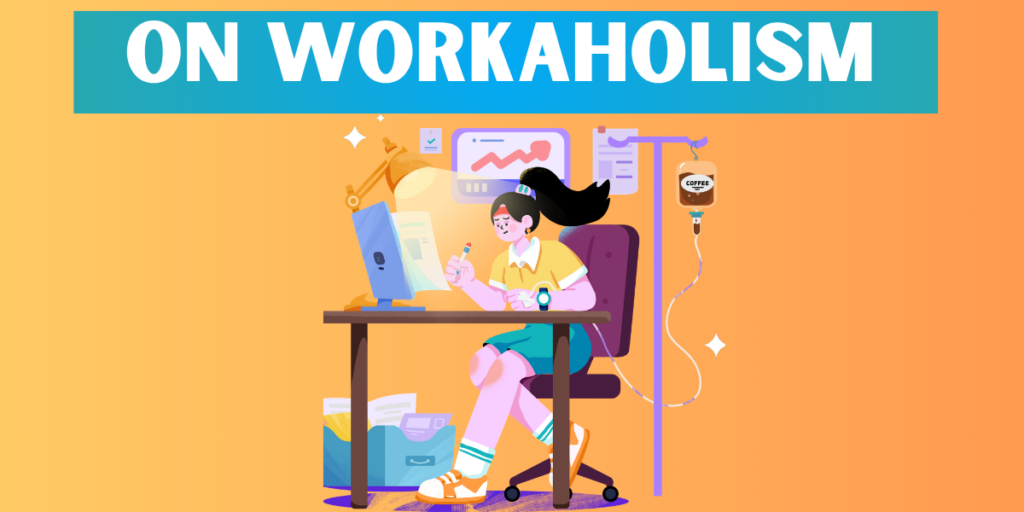
But let’s be real: work can be just as harmful an addiction as anything else. Just as detrimental and just as destructive. What sets workaholism apart from most other addictions is that it’s a socially praised addiction.
To put this in perspective: imagine gambling your savings away and being celebrated on the cover of Forbes for that very action. Or relapsing on a substance while your family cheers you on, holding you up as their success story.
That’s the warped logic of workaholism: dying and calling it winning.
In the nonprofit world, workaholism can look like:
- Responding to emails from the couch at 10pm
- Skipping meals and rescheduling (or never scheduling) doctor’s appointments
- Saying yes to every request because it makes you a good boss or coworker
- Diving deeper than a project’s initial scope because you need to solve a problem
- Wearing seventeen hats and quietly expecting your team to do the same
- Making your job your entire personality
- Not remembering the last time you took a real day off
- Consistently choosing work over family
- Thinking you’re the only one capable of completing a task or project
- Measuring your self-worth by your organization’s impact and/or revenue
- Renaming stress and hyperactivity as dedication to the cause
- Overly discussing work with friends and family
- Taking over someone else’s project
- Bumping back a vacation or returning early from a break
- Guilt-tripping yourself for leaving at 3pm even when you’re working 50+ hours this week
- Just doing one more task/email for the day (then 2 hours go by)
How does workaholism show up for you?
Chasing a High that Never Really Came
The harder you work, the more successful you will be.
I believed it. I had taken the blue pill and assumed that working hard was the backbone of a meaningful career and life. And when working harder than everyone around me (at least my perception at the time) didn’t lead to notoriety or financial security, I turned that failure inward.
Something is wrong with me. I must be broken.
So I worked even harder. I had five jobs simultaneously. At one point, I had seven email accounts and two phones. I pulled all-nighters and worked around the clock. 3 days a week, I worked 20 hours straight and could just barely make rent. I was doing everything “right” by those rules, and it still wasn’t enough.
But eventually, when you’ve spent years grinding and watching others get opportunity after opportunity, you stop blaming yourself and start asking a different question entirely: who set these rules, and for whom?
The answer, when it finally came, was clarifying and infuriating in equal measure. Capitalism, corporations, patriarchy, and other systems were built to benefit a small minority of the population. And I had been following it religiously, killing myself to win a game that was never designed for me to win.
When nonprofit leaders, especially women and nonbinary leaders, exhaust themselves chasing the golden fleece in a society that insists they must, but quietly refuses them entry – or allows limited entry under certain circumstances, it begs the question:
Is our workaholism serving a system that benefits directly from our depletion?
This is “A” Way
My personal breakthrough moment didn’t come through Workaholics Anonymous or a therapist (although those definitely have their place). It came when I read Maureen Murdock’s The Heroine’s Journey.
Murdock wrote the book as a feminist response to Joseph Campbell’s The Hero’s Journey. Campbell’s work encapsulates the classic hero’s arc: the call to adventure, training with the mentor, the battle, and the triumphant return home with riches and glory.
The problem with Campbell’s framework was that he believed the journey was exclusively a male experience; others existed at the edges of the story, patiently waiting for the hero to return or interact with them.
Murdock’s reframing in The Heroine’s Journey provides an alternative: seeking wholeness, not literal gold and accolades. And her path is not linear, does not end, and it is not exclusively one gender’s journey. The heroine’s journey is for anyone carrying the weight of rejected parts of themselves: women, nonbinaries, and yes, men too!
The heroine’s path cycles seasons of action and rest, expansion and descent, community and solitude, and it seeks to heal the feminine and masculine within us all. Descent and regress in this model are not signs of failure or ‘trials’. They are natural and necessary.
For those of us who have spent careers trying to out-perform, out-produce, and out-hustle within systems that were never designed to let us win, Murdock’s philosophy is a revelation in redefining success, work, advocacy, community, and rest.
In case someone hasn’t told you: there are alternate ways to achieve incredible impact without risking your life to get the grail.
Prior to reading The Heroine’s Journey, workaholism led me to try and impress the men in my life. Living in a patriarchal society meant I had to prove, despite the “wrongness” in me, I could perform better than men… right? And once I understood that a significant part of me was laboring to impress men who would not even let me golf with them (despite my 250 yard average drive off the men’s tee), I broke free of the ‘hero’ success trap pretty damn quickly.
The Journey to Wholeness: New Rules
Here is what nobody tells you about dismantling workaholism (and the traditional patriarchal structures that embolden it):
The antithesis to workaholism is NOT laziness; it’s freedom and personal fulfillment.
For me, this means learning on a daily basis what I actually need. Not want. Not wish. Not what I should be doing according to others (my therapist tells me ‘should’ is a shame-based word… WOOF). But what do I need my days to be for my own personal fulfillment?
In my journey toward wholeness, this is what it actually looks like:
- I turned off phone notifications for a medical procedure and never turned them back on. Contrary to everything I had believed, the world didn’t end. And people were still able to reach me during office hours. Imagine that.
- I stopped caring what men in my life thought of me. When there is no one left to impress or prove yourself to, there is no need to seek trophies. I try to let ideas breathe and wander, and let actions flow naturally out from me.
- I don’t have meetings after 2pm. A preference, stated and held on my calendar (thank you Chelley McLear for the inspiration). This one boundary changed my productivity, my workflow, and how I show up for nonprofits.
- I actively choose group participation. A creative, psychologically safe work culture is better than a flawless, perfect system. I started measuring wins by positive team culture moments first. The Perfectionist Toddler in my brain still screams from the backseat sometimes. But I can still drive.
- I try to stop fighting the clock. I was never good at breaks or time management. So instead of engineering the perfect schedule (see hustle culture’s ‘my 5-9 after my 9-5’ social trend), I started working with my natural rhythms. When I want coffee or food, I get it. When the day reaches a natural close, I end it. When I need a nap, I take one. And yes, when I feel like working late or over the weekends, I do that too (but way less often than I’ve done before).
Dismantling workaholism doesn’t mean stopping work, it means having the freedom and choice to work or not work, and being happy with your decision.
Recovery, like any addiction, takes a lifetime to manage. But naming it is the beginning of unraveling its hold and control on your life.
From one recovering workaholic to another: I wish you peace, and I wish you rest… even if you’re not sure what that feels like yet. (I’m still figuring that out myself.)