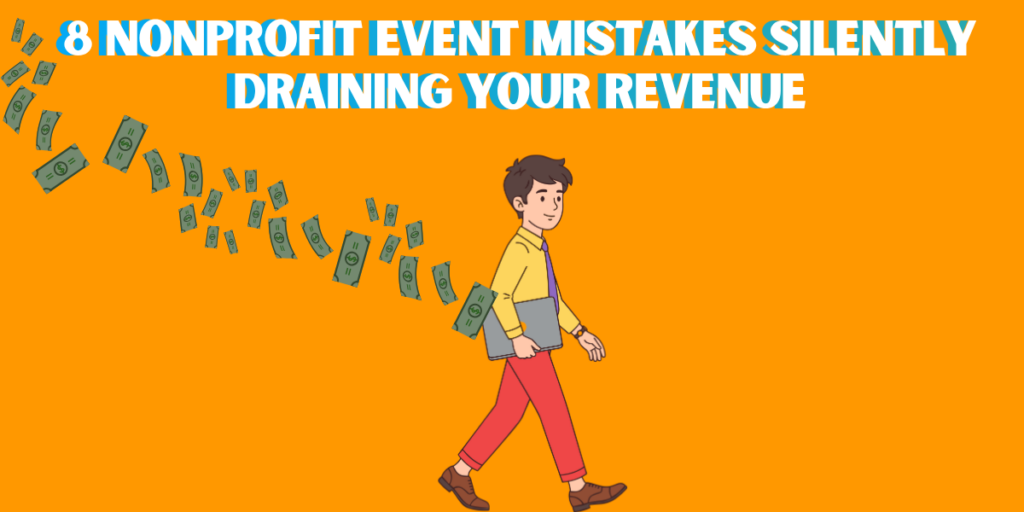
Your event was a hit. The room was full, the energy was good, and everyone left happy.
And yet… you don’t know exactly how many people showed up and you don’t have many email addresses to follow up with. Then the board asks for a “quick impact summary” that you don’t have all the data for.
Sound familiar? Your events take real staff time and energy to pull off. When the administrative follow-through slips, you’re not just missing data, you’re leaving the return on that investment sitting on the table.
Here are 8 common misses we see nonprofits make when managing events:
1. Planning Starts Too Late
Your event needs to be roughed in 1-2 years in advance. Not the details, of course. Just the approximate timing, a short description, who’s involved, and what community will be impacted. Why so early? Grants — you’ll need to know this information anyways as you’re applying. It’s way harder to figure out the details of an event to fit a program grant when there’s a countdown to a submission deadline. Get ahead and outline your event 16 months in advance.
Then, ahead of its fiscal year, go back to that event and fill in the who, what, when, where, and why in more detail. This is what allows your programs and communications team to get ahead of the game instead of scrambling. The worst-case scenario for your community? Your core audience finds out about the event after it happened. Don’t let that be you.
2. Goals Are Vague or Missing
If you ask five people on your team what the event is “for,” and you get five different answers, that’s a problem.
Some examples of real, measurable goals:
- Hit a certain attendance record
- Deepen engagement with existing supporters
- Feed 500 families in 2 hours
- Bring in 10 first-time recurring donors
- Get new board member inquiries
- Expand your volunteer list by 30
Pick your goal(s) before you plan a single logistics detail. Everything else: your marketing, your ask, your follow-up, your grant report — should point back to it.
3. Contact Information Goes Uncollected
This one seems obvious. If you’re not collecting email addresses at the door, at check-in, or through registration or event ticket, you’re leaving your entire post-event strategy on the table before it even starts.
Now, if you’re serving a hot meal or handing out free school supplies to families in need, required registration may not be appropriate. But, in those cases, it is still valuable to have the option available. People will add their email to a list for many reasons — perhaps they would like to volunteer or know when your next event is.
In general: your community needs your services and most want to know about what you’re doing, or they wouldn’t be there in the first place. Sharing their email address is one way they can stay connected.
4. Attendance Goes Untracked
Who actually showed up to your event? Attendance tracking tells you the difference between who registered and who walked through the door. That gap matters for your reporting, your grants, and your next event plan.
Who missed out? Would it be valuable to give a recap or shared resources that they missed out on?
If you can do nothing else, at the very least, count. How many people walked through the door? How many meals were served, how many bags of groceries handed out, how many families came through the line? You don’t need names to track that. But you do need the number, because that number is exactly what your donor community and funders want to hear about.
5. Impact Isn’t Captured During the Event
Are you capturing demographic data while people are actually in the room? What is the most important data to you, and how will you do so? There are a variety of ways for guests to self-identify beyond a paper survey, that can enhance the engagement and enjoyment of the event. From differently shaped glass beads in a jar (age), to colorful ribbons tied to a rope (ethnicity), to pins on a map (country of origin), the sky is the limit when tracking demographics at your event.
Also worth capturing in real time:
- The phrases you hear guests say in conversation (pass out little notebooks for your staff to keep on hand)
- Photography and video
No budget for a photographer? Utilize volunteers, board members, or your comms team to grab key moments and crowd shots. You don’t need a professional shoot, you need proof your event happened and mattered.
6. The Direct Ask Doesn’t Happen
Your room is full. Your guests are moved and engaged. And then… nobody asks them for anything.
This is one of the most common (and most fixable) misses in nonprofit events: being too shy to make a clear, direct, concise ask in the room. Not a vague mention of “ways to give” buried in a program. Not a QR code on a slide nobody reads. An actual human, at the mic or in conversation, saying: here’s what we need, here’s why, and here’s exactly how you can help right now.
Guests can’t say yes to an ask you never make. Decide who’s making the ask, script it ahead of time, and give it the same prep and polish you’d give your keynote. Then let that moment do double duty. Share it with your wider community after the fact, and you’ve turned one event into a bigger circle of support.
7. The Follow-Up Email Doesn’t Get Sent
In the nonprofit arts and culture industry, post-event recap emails get some of the highest open rates in email marketing. We’ve seen 70% or higher pretty regularly when sent within 2 days after the event. That’s a huge, warm audience paying attention right after your event ended.
So: with all those eyeballs, what story will you tell? What will you ask from them?
8. The Post-Event Report Doesn’t Get Written
What worked? What didn’t? Who attended, demographically? What were the highlights? How many families were impacted, how many supplies were donated? What’s the qualitative and quantitative story you can hand to grantors and funders, quotes included?
If your org runs more than 12 events a year, a full report on every single one probably isn’t realistic. That’s okay. Stick to your core programming: the events that reach the most people and the ones tied to grant funding. Those are the ones worth the time and energy.
Managing events is hard enough without administrative gaps eating into your impact. Want to outsource your fundraising or communications work? Email us at info@nextinnonprofits.com.